
Jacksonville Previous Resident Eras
Different sources carry different parts of the Jacksonville address trail. The current parcel, tax record, and recorded deed are the starting point for the recent period. Older directories and telephone books offer dated household snapshots. Census and newspapers help test a household connection, but their geography and editorial coverage can differ from a modern street address. Onslow’s deed books are described as reaching from 1734 to the present, although that physical-record horizon is broader than the public online index windows.
| Evidence layer | Years represented | Where to use it | What it can show |
|---|---|---|---|
| ROD deed books and archival records | 1734 forward for deed books | Register of Deeds, counter, State Archives | Legal parties, descriptions, conveyances, estate links |
| Census resources | 1790–1950 at the library | Tucker Littleton Room databases and indexes | Household and locality context, not always address-exact |
| Local newspapers | 1938 to present | Tucker Littleton Room; catalog routes for selected titles | Notices, announcements, obituaries, and events |
| Digitized directories | 1948, 1957, 1958, 1960, 1961 | DigitalNC / UNC collection | Names, addresses, occupations, phones, householders |
| Local directory and phone runs | Directories 1960–2019; phones 1957–present | Tucker Littleton Room | Repeated dated address snapshots |
| Online real-estate indexes | 1977–1994 pre-95; 1995 forward consolidated | ROD index, PropertyCheck, book/page route | Bridge from a modern deed to prior transfers |
Choose the layer that fits the date. A past-residents search for a 1940s household should not stop at today’s tax card, and an earlier deed should not be called absent just because it is outside the online date range.
Jacksonville Previous Residents Start Here
Begin by anchoring the address to its current parcel. The Onslow GIS Parcel Viewer can return a physical address, PIN or NCPIN, PARID, current deed book/page, legal description, sales details, map geometry, township, and city or ETJ layers. Then compare the result with Onslow Tax / Property Search. The tax record is an assessment source, while the GIS record offers map and deed-reference context. Mailing and situs addresses serve different purposes, and neither alone proves who lived at the parcel.
Use the current deed book/page as the bridge to the Register of Deeds. Preserve the physical address, parcel number, legal description, and book/page in notes. Those identifiers remain useful when a street name has changed, an older directory uses a landmark, or a later mailing ZIP is different from the address used in a historic record.
Onslow Tax Bill Search shows the county’s separate property and tax fields for a current address check.
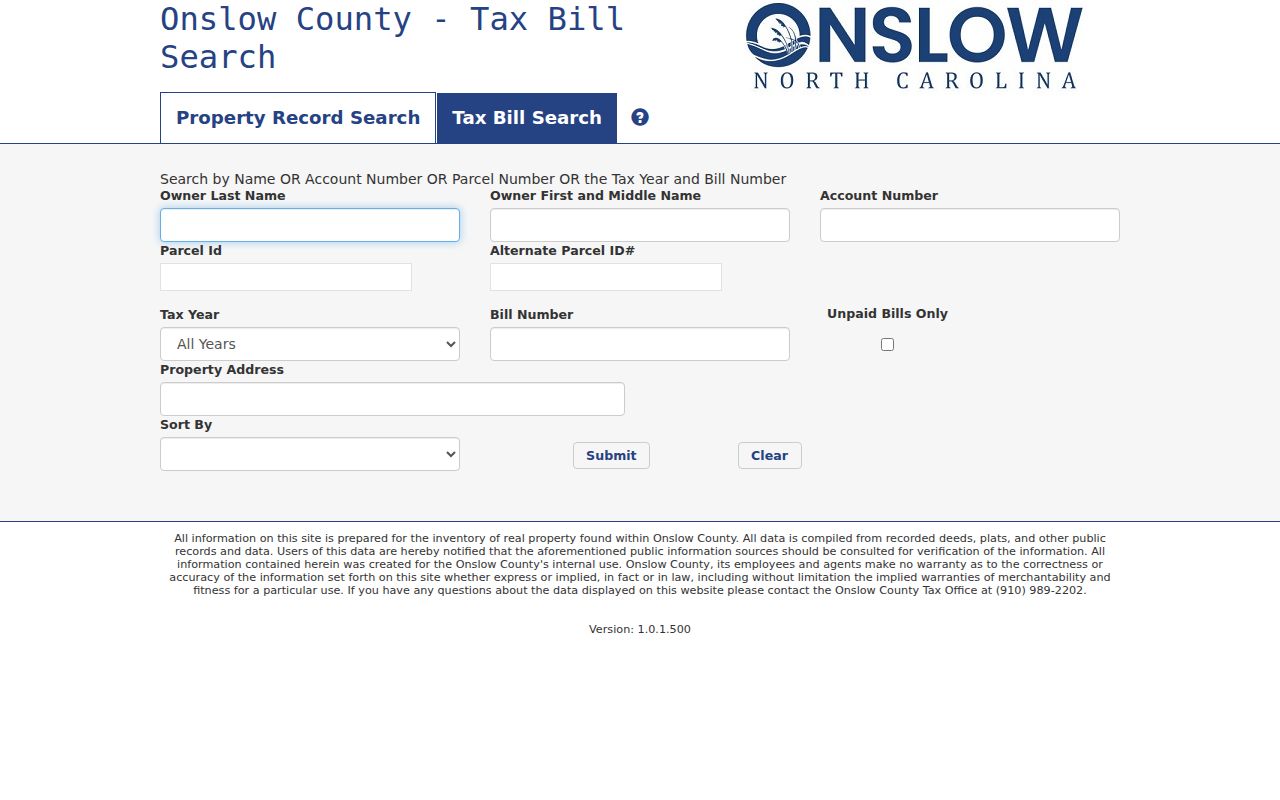
Tax year, parcel, account, and address controls can clarify the assessment record that precedes a deed search, but the result is still not a household roster.
Jacksonville Deed Chain Backward
A title trail is the backbone for researching former Jacksonville owners. Onslow’s Register of Deeds index offers Indexed Records, Quick Name, Advanced Name, Property, Book/Page Number, File Number, Date Range, Pre-1976 Dates, and Certified Dates. Begin with the current book/page from GIS or the property record. The instrument’s derivation clause often names the prior deed. Use that citation to locate the earlier transfer, then repeat. If a prior link is unclear, search the named earlier party in the appropriate grantor or grantee role and compare legal descriptions rather than relying only on a matching street address.
- Record the current parcel’s situs address, legal description, and current deed book/page from GIS or Tax Search.
- Find that instrument in the Onslow Register of Deeds index or the active PropertyCheck interface.
- Read the grantee, grantor, recording date, instrument type, and derivation clause. Save the cited earlier book/page or document number.
- Open the prior transfer and test the legal description against the parcel. Reverse-search a named prior party when the clause does not carry the chain far enough.
- When online coverage ends, use the pre-1976 path, book/page search, ROD counter, State Archives, or Tucker Littleton Room microfilm instead of ending the trail.
- Grantor
- The party conveying an interest in a recorded instrument.
- Grantee
- The party receiving that interest. A grantee may be an individual, trust, organization, or other entity.
- Chain of title
- The sequence of recorded transfers linked by instruments and legal descriptions.
- Legal description
- The formal land description in a deed or plat. It is often more durable than a street address for matching old records.
The ROD portal notice explains guest access and account conditions, and notes the transition toward PropertyCheck.
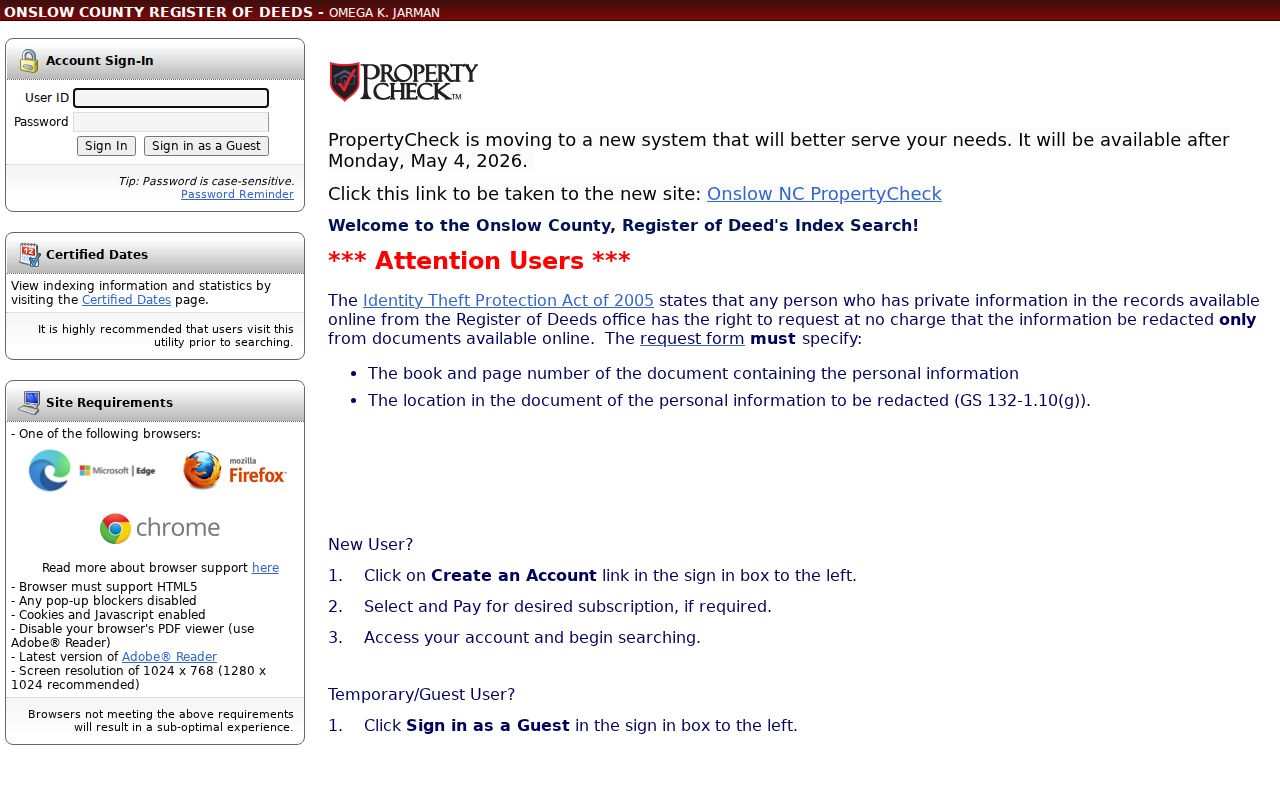
Some images or enhanced access may require a guest account, payment, or a counter visit, so the index record and book/page remain important even when an image is not immediately available.
Jacksonville’s 1977 Deed Bridge
The ROD’s observed certified-date information separates the online real-estate periods. Pre-95 real estate runs from 1977 through 1994, while the consolidated real-property window begins in 1995 and extended through the observed 2026 date. That makes the 1977 bridge a useful handoff point, not the beginning of land history. The county’s deed-book statement reaches back to 1734. Older material can require a book/page lookup, microfilm, State Archives help, a library visit, or the Register of Deeds counter.
North Carolina Public Records Law, N.C. Gen. Stat. Ch. 132, supports inspection and copying of existing public records at reasonable times, but it does not require a custodian to create a custom list of prior households. A request works best when it names the existing book/page, office, record type, date range, and preferred format.
The ROD Certified Dates page is the right place to confirm the active index windows before choosing a route.
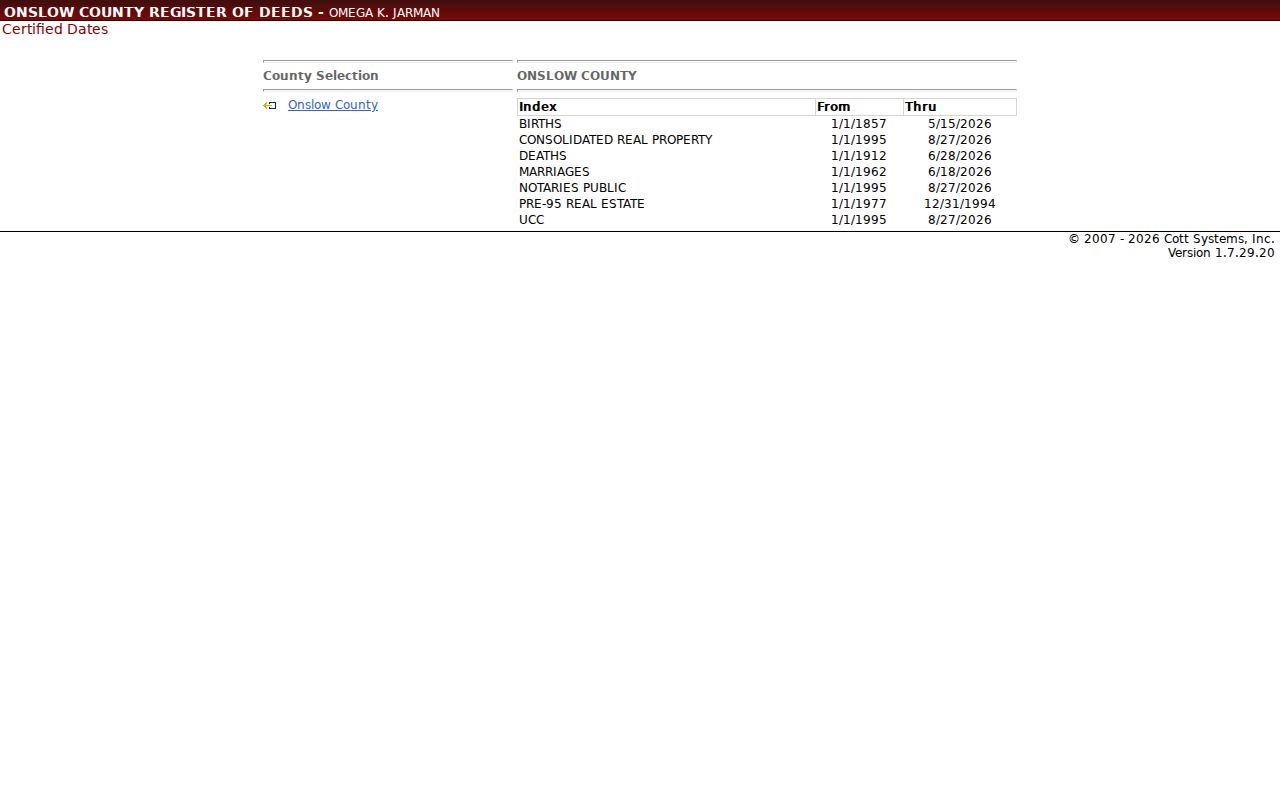
The distinction between deed-book history and the online index window prevents a false “no record” conclusion for an older Jacksonville address.
Insider tip. When a deed chain stalls, use the derivation clause, then reverse-search the named prior grantor. Move to the book/page, counter, Archives, or microfilm route when the online index ends.
Jacksonville Previous Residents Insider Tip
Deeds identify legal parties. Dated directories offer a separate household layer for past residents. The Tucker Littleton Room documents Jacksonville city directories from 1960 to 2019, telephone books from 1957 to the present, and newspapers from 1938 to the present. DigitalNC offers editions for 1948, 1957, 1958, 1960, and 1961. The 1960 Hill directory is especially useful because its householder section runs in street and address order, with names opposite addresses, intersecting streets, occupancy-status notation, and telephone numbers where printed.
Read an entry as a dated editorial snapshot. A person may be omitted as a non-subscriber, the household marker may not represent everyone at the address, and a listed telephone does not prove a whole year of occupancy. Keep the edition, page, and section type with every note. The publisher’s 1948 and 1957 introductions are historical statements for those editions, not current population or business counts.
The Tucker Littleton Room genealogy and local-history service is the local route for the physical holdings and assistance.
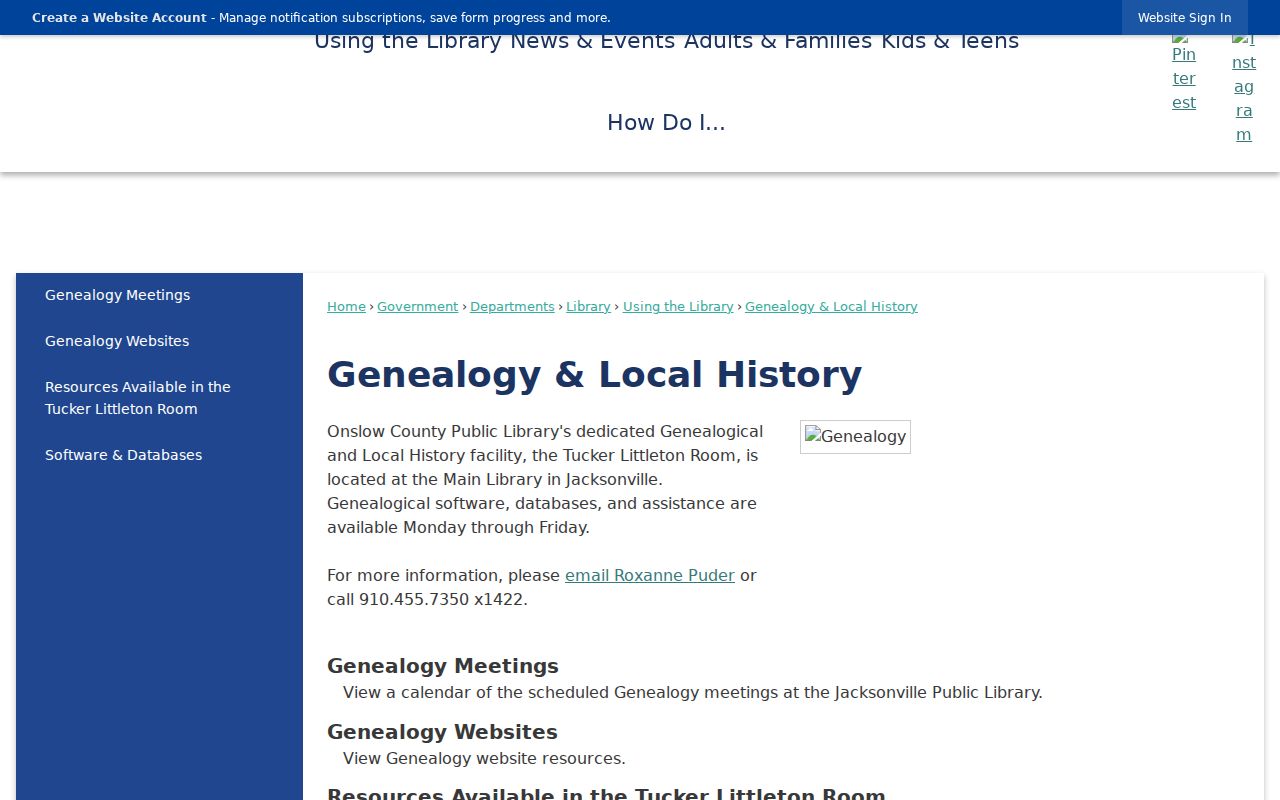
The room also provides a genealogy workstation, microfilm reader, vertical files, and historical sources that extend beyond an online directory scan.
Collection details and entry-reading guidance appear on the Jacksonville city directories page. Use that collection work to support an address trail rather than treating one printed line as final proof.
Jacksonville Directory and Census Pairing
Pair a directory year with the closest available census and newspaper evidence. The library offers Onslow census resources from 1790 to 1950 through Ancestry Library Edition, the North Carolina census index, and HeritageQuest. Census geography can be a township or enumeration district rather than a modern Jacksonville address, especially during periods of county growth. The match works best when the street, household names, occupation, approximate age, and parcel or deed context point in the same direction.
- Start with the directory’s year, address, section type, and the spelling printed in that edition.
- Check the householder street section when available, then preserve any printed occupancy-status notation without expanding it into an occupancy claim.
- Use the closest census record for household and locality context, allowing for township or district labels.
- Search the local newspaper run for dated notices, announcements, legal notices, or obituaries, recording the title, issue date, and page.
- Return to the deed chain and compare the legal description or parcel history before joining a household to a particular property.
DigitalNC’s 1957 Jacksonville directory record provides a digitized edition from the directory era.
A digital edition is most useful when its year and page are paired with independent land or household evidence.
Jacksonville Maps and Address Context
Sanborn material adds building context to a Jacksonville address history. North Carolina library references document two Jacksonville volumes spanning 1925 to 1943, with the 1925 map held by UNC Chapel Hill’s North Carolina Collection and Digital Sanborn available through library resources. These maps can show building footprints, materials, uses, and street setting. They do not provide a complete occupant list. Use them to test whether a structure or street configuration fits the date, then return to deeds, directories, and census evidence for people.
The Mill Avenue neighborhood and Riverwalk Crossing area offer a local example of why map context matters. The city’s downtown plan identifies Mill Avenue as a locally designated historic district and discusses the train depot, riverfront homes, Old Bridge and Anne Street context, and Sturgeon City. Those landmarks can help interpret an older address description, but they do not substitute for a parcel or deed match.
DigitalNC’s 1960 Jacksonville directory record documents the edition with alphabetical, householder, Yellow Pages, and numerical telephone departments.
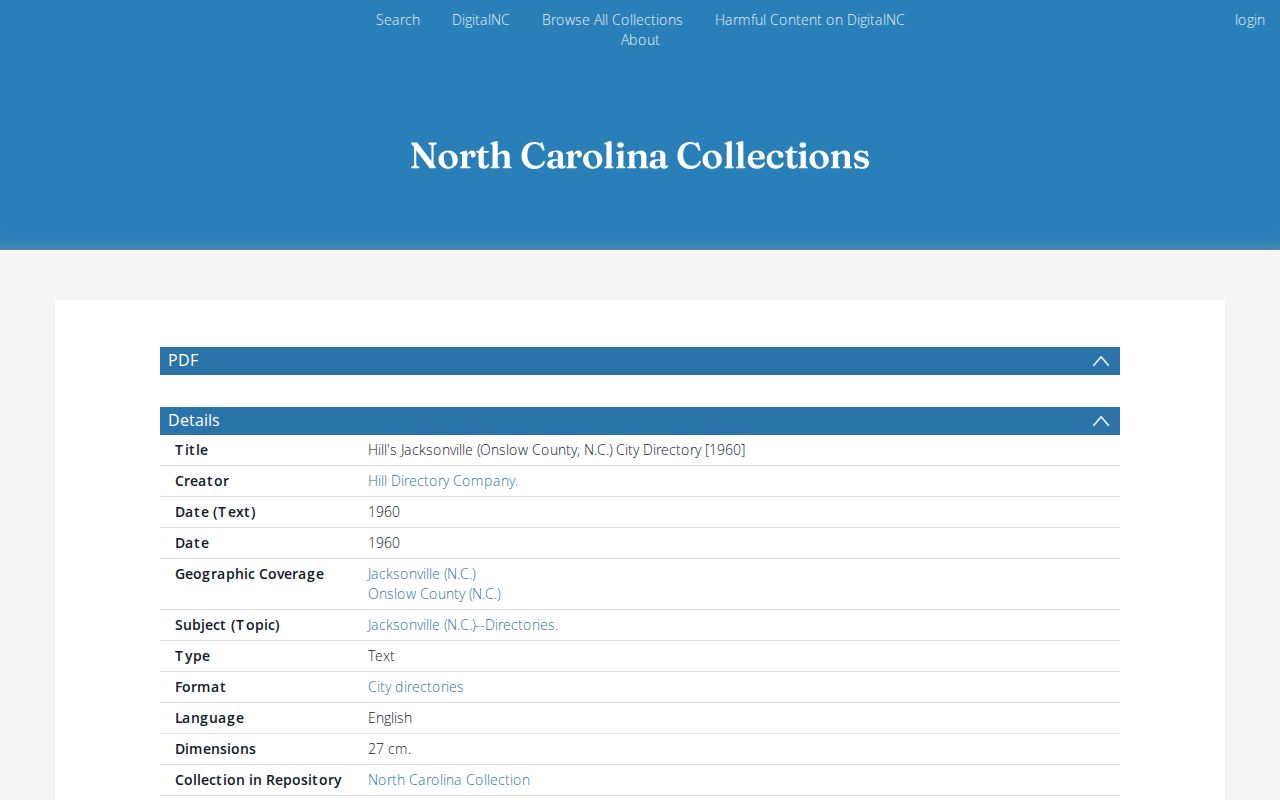
The address-order householder portion is a stronger starting point for a past Jacksonville house than an alphabetical name search alone.
Jacksonville Previous Resident Endpoints
Probate, estate, and court records can explain a transfer at the end of an address trail. The Onslow Clerk of Superior Court handles estates and special proceedings, with appointments for Estates/Special Proceedings. The NC Courts Portal supports name and case-number searching for public case information, while courthouse public terminals and the clerk file remain the route for the record itself. An estate file can identify a decedent, executor or administrator, heirs, property, notices, accountings, and dates, subject to redaction and confidentiality.
For deeper early history, the State Archives route includes Onslow land grants, court minutes, wills, estates, guardians, and military papers. The Archives copy form needs identifying details, and a deed request needs book/page information. That specificity is more productive than a broad request for every former Jacksonville resident at an address.
Note: A probate sale or estate reference can connect a person with a parcel, but it does not prove that person occupied the property.
Jacksonville Past Resident Myth
Myth: A deed lists everyone who lived in a house. A recorded instrument identifies legal parties to a transfer, while the household layer requires separate dated evidence and may remain incomplete. A directory can add a name for a particular edition, and census or newspaper work can test the time and locality, but no single source turns an address into a complete list of people who lived there.
Jacksonville Previous Resident Limits
Past-residents research has firm limits. A tax mailing address is correspondence data, not proof that its recipient lived at the parcel. A voter registration address is not title or a household census. A directory may omit non-subscribers and reflect a delayed editorial update. Deeds establish legal conveyances, not day-to-day occupancy. North Carolina’s public-records rules also preserve confidential information, including protected voter addresses, vital-record restrictions, adoption material, driver-license data, and some court or law-enforcement material.
Lawful use. Jacksonville house-history research supports family history, heir research, and personal curiosity. Never use a past address trail to stalk, harass, intimidate, or harm a living person.