
Jacksonville City Directory Holdings
Jacksonville city directories survive in a mix of digitized editions and local-library runs. The named collection is important because a telephone book is not the same thing as a city directory. The library lists directories for 1960 through 2019, telephone books from 1957 forward, and local newspapers from 1938 forward. DigitalNC supplies several earlier scans. Together, those sources offer snapshots rather than a continuous census of every resident.
| Directory collection | Dates represented | Custodian | How to use it |
|---|---|---|---|
| Carolina Publishing Co. Jacksonville/Onslow volume | 1948 | UNC North Carolina Collection and DigitalNC | Digitized record and PDF |
| Hill Directory material | 1957, 1958, 1960, 1961 | DigitalNC | Digitized editions |
| Jacksonville city-directory run | 1960-2019 | Tucker Littleton Room | In-person local-history research |
| Jacksonville telephone books | 1957-present | Tucker Littleton Room | In-person historical comparison |
| Jacksonville newspapers | 1938-present | Tucker Littleton Room | Microfilm and local collections |
The research does not document a separate official Jacksonville reverse-directory run. The 1960 Hill volume is the useful substitute because its householder portion puts names opposite addresses in street order. Missing a name can mean the volume's editorial rules, a subscriber omission, a move, or a gap in the surviving run. It does not prove that a person was absent from Jacksonville.
Jacksonville City Directory Research at Tucker Littleton
The Tucker Littleton Room at the Onslow County Public Library is the local starting shelf for city-directory work. The Main Library is at 58 Doris Avenue East in Jacksonville. Listed library hours are Monday through Thursday from 9 to 8, Friday and Saturday from 9 to 6, and Sunday from 1 to 5. Genealogy and local-history software and help are available Monday through Friday. The room has a genealogy workstation, a microfilm reader, local and family-history vertical files, and copies or prints at $0.20 per page.
The library collection listing also identifies census access from 1790 through 1950, early Onslow microfilm, the ROD index, and licensed research databases. That makes a room visit useful when a digital edition produces a surname but leaves an address change unexplained. Ask for the specific year, city directory or telephone-book run, and whether a newspaper reel or census source can test the same name.
The genealogy and local-history page is shown in this Jacksonville city directory research image.
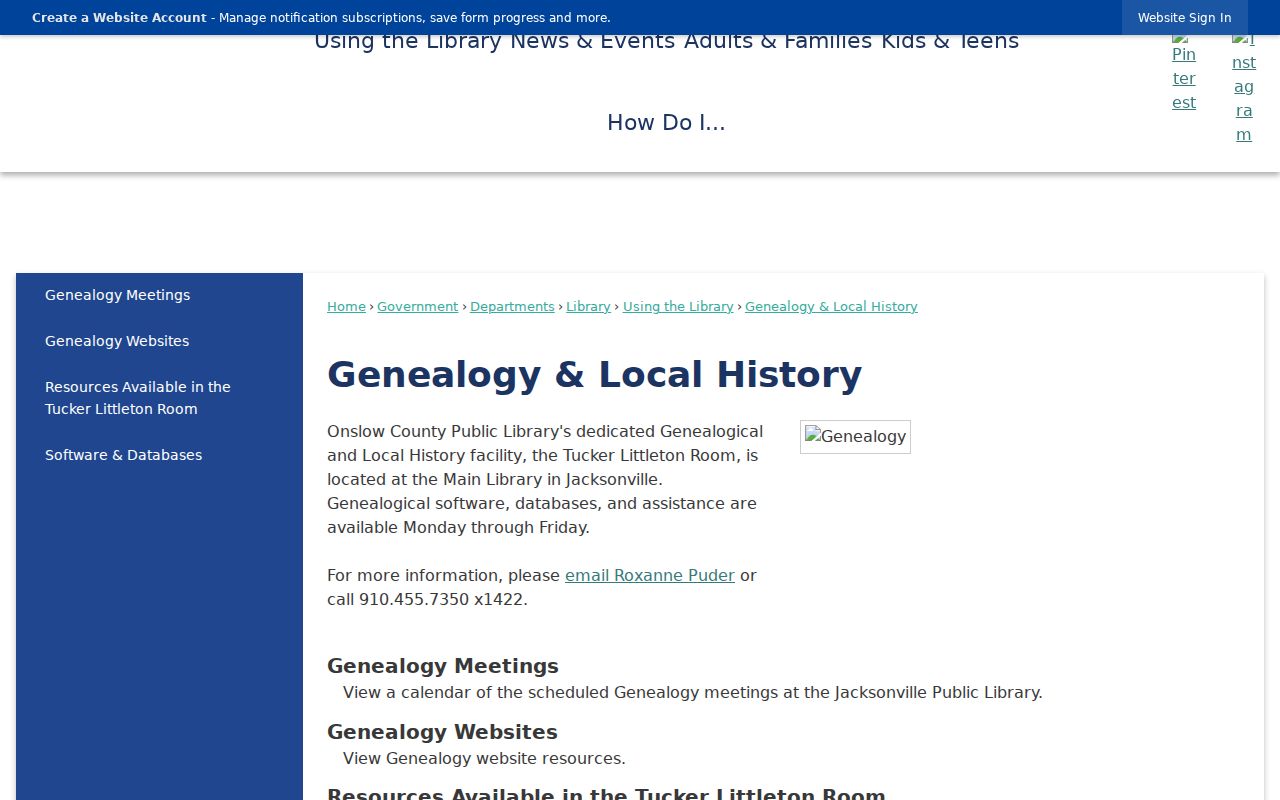
The local room is a fallback when an online index ends, and it provides a way to inspect the actual edition, its abbreviations, and nearby supporting sources.
Note: Call 910-455-7350 before a special trip, especially when a particular microfilm reel, workstation, or staff assistance is needed.
Digitized Jacksonville City Directory Editions
Digital access begins with the 1948 Jacksonville directory record, published by Carolina Publishing Company and held in the UNC Chapel Hill North Carolina Collection. Its introduction calls Jacksonville the county seat and describes the regional role of Camp Lejeune. It also reports roughly 1,000 telephones. That last detail is a warning: phone coverage was not a full count of residents. Preserve the edition, page, and type of entry when saving a finding.
Hill Directory material adds 1957, 1958, 1960, and 1961 snapshots. The 1957 introduction contains population, permit, transfer, industry, and utility figures that belong to the publisher's period, not to present-day Jacksonville. The edition itself is valuable because it places its list of people and firms in a dated local setting. The transition from Carolina Publishing to Hill Directory material is also a useful timeline marker when comparing entries.
DigitalNC's 1957 Jacksonville directory record provides a direct route to one of the Hill editions.
Use the digitized record to identify the volume first, then cite the page in notes so another researcher can return to the same entry.
| 1948 | Carolina Publishing Company volume, digitized through DigitalNC. |
|---|---|
| 1957 and 1958 | Hill Directory material with publisher-era local context. |
| 1960 | Hill Directory Co., Inc. volume with four distinct departments. |
| 1961 | Hill material with telephone and listing pages. |
| 1960-2019 | Local city-directory run listed by Tucker Littleton. |
Four Parts of a 1960 Jacksonville City Directory
The 1960 Jacksonville directory is more than an alphabetical name list. Its introduction describes Yellow Pages, an alphabetical section for adult residents or firms, a householder directory arranged by streets and avenues, and a numerical telephone directory. The householder pages list numbered and named streets, names opposite addresses, intersecting streets, owner or tenant notation, and phone numbers. That street-order department is the documented local substitute for a separate criss-cross directory.
Start in the alphabetical section when a surname is known. Move to the householder section when an old address is known. A phone number can lead to the numerical section, but it should be treated as period context. A person may be omitted, a business may share a number, and the listing may have changed before printing. The strongest conclusion comes from matching the same address or legal parcel across a second dated source.
DigitalNC's 1960 record illustrates the edition that documents this four-part structure.
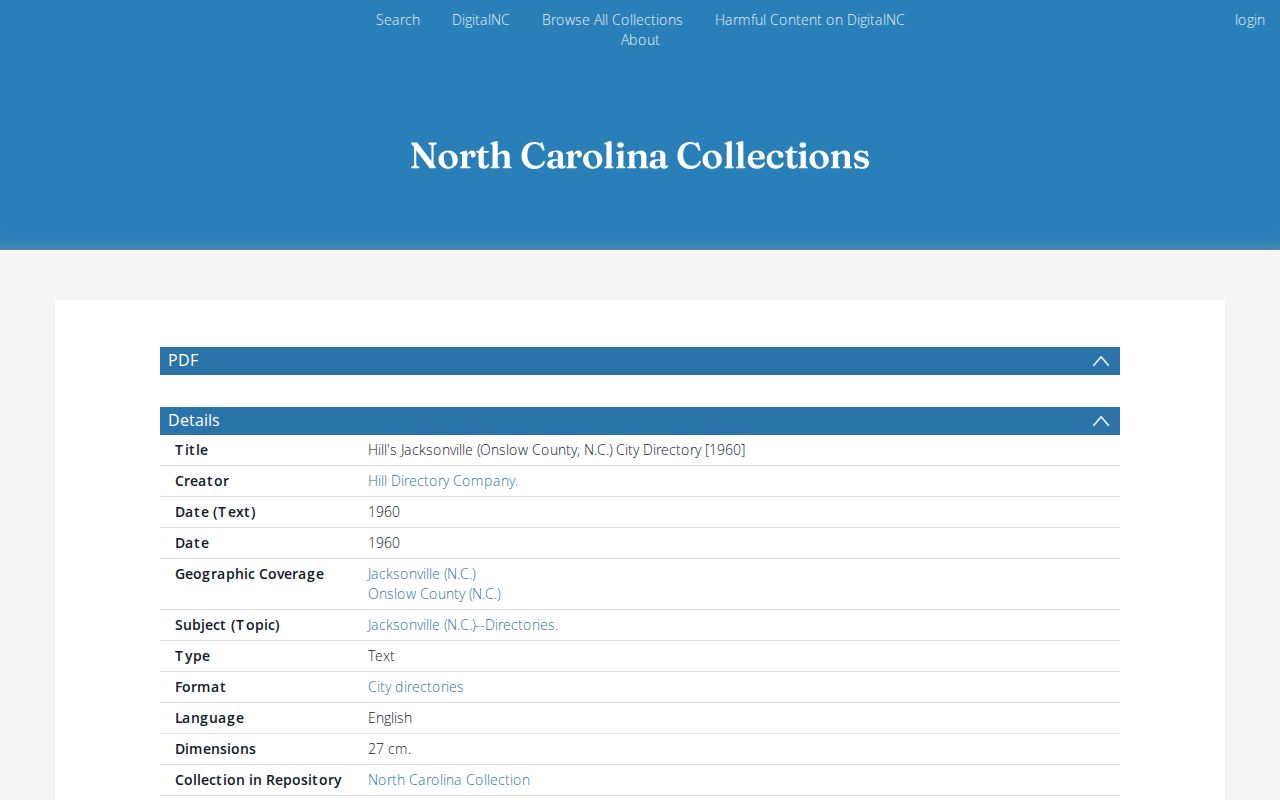
The 1960 edition gives Jacksonville researchers a practical way to turn a known address into a contemporaneous household listing without claiming a complete reverse-directory series.
Fields Inside a Jacksonville City Directory
A city directory entry needs to be read as a compact editorial record. In the 1960 alphabetical pages, the documented field classes include surname and given name, a marital-status marker where printed, occupation, street address, firms or business information, and telephone number. The householder pages add the street, address order, the household name opposite the address, and an owner or tenant designation. Those are useful clues, but none turns an entry into proof of title or full-year occupancy.
| Name and marker | Identifies the printed person and, where present, a marital-status marker. |
|---|---|
| Occupation or firm | Period context that can distinguish people with the same name. |
| Street address | A dated location clue, best checked against other records. |
| Householder notation | Street-order pages can place a household name opposite an address. |
| Owner or tenant notation | A printed directory classification, not a replacement for a deed. |
| Telephone | A historical subscriber clue, not a complete resident roll. |
- Criss-cross directory
- A directory arranged by address or street rather than by surname. Jacksonville's documented substitute is the 1960 householder section.
- Householder index
- A street-order listing that places a household name at an address and may show owner or tenant notation.
- Abbreviation key
- The volume's guide to shortened words and marks. Read it before deciding what a printed notation means.
Trace Jacksonville Households Through City Directories
Follow a household year by year rather than treating a single Jacksonville city directory entry as the whole story. Begin with the closest known edition and copy the name spelling, address, occupation, phone, and any owner or tenant notation exactly as printed. Then work backward and forward through available editions. The library's city-directory and telephone-book runs make that comparison possible in person, while the digitized editions offer selected earlier checkpoints.
- Find the surname in the closest directory year and record the edition and page.
- Check the householder section for the address and intersecting streets when the volume has one.
- Compare the next available directory or telephone book for a move, name variant, or changed occupation.
- Pair the dated address with the appropriate census source, keeping township and county geography in mind.
- Use a newspaper issue, deed reference, or probate record to test a major change in the trail.
A disappearance can mean a move, death, omission, altered name, military connection, or a change in the book's coverage. Jacksonville's postwar growth and the Camp Lejeune region make geography especially important. A military-associated postal label or old street wording should be retained in notes rather than silently translated into a modern city address. For a present-day record check after a historical find, use the focused paths in the Jacksonville resident lookup.
Note: Census geography can be township or county based, so match the date and address before treating a census household as a city listing.
Jacksonville City Directory Gaps and Newspapers
Local newspapers often fill the interval between two city-directory editions. Tucker Littleton lists Jacksonville newspapers from 1938 forward. The Library of Congress catalog also provides calendar routes for Daily News, cataloged from 1954 to the present, and News and Views, cataloged for 1946 through 1952. Look for legal notices, civic-club references, marriage announcements, business advertisements, and military arrivals, then record the paper title, issue date, and page.
No official local obituary-index run was located in the research. The documented fallback is to ask the Tucker Littleton Room or inspect the newspaper microfilm. Newspapers add context, not automatic proof. An address in an advertisement may be a business address; a social notice may use a nickname; and a city directory may use a different spelling. When the same date, address, and household appear in more than one source, the record trail becomes stronger.
Jacksonville City Directories Are Not Complete Rolls
A printed telephone entry or city directory is not a complete list of everyone in Jacksonville. The 1948 introduction's telephone count shows why subscriber material is narrower than a resident count. Editorial timing, non-subscribers, business listings, household conventions, and address changes all affect what appears. A city directory is best used as a date-stamped lead for family history, a classmate search, estate research, or a question about an older address.
North Carolina's public-records law, commonly called the North Carolina Public Records Law, allows inspection and copying of existing public records at reasonable times, but it does not require a custodian to compile a new citywide resident list. When an online collection stops, the appropriate next channel may be a library visit, microfilm, a named archives request, a county counter, or a targeted records request. Use records for lawful personal research and never use a historical listing to stalk, harass, or harm someone.